[photo by Emilio Morenatti]
Thursday, May 12, 2016
Fischer, Karpov Linked to Panama Papers
[photo by John Lent]
Former world champions Bobby Fischer and Anatoly Karpov have been linked to the Panama Papers scandal.
Wednesday, May 11, 2016
Public School 77 Wins National Championship
[photo by Caitlin Ochs]
Tuesday, May 10, 2016
Marshall May Weekend FIDE 5/8/2016
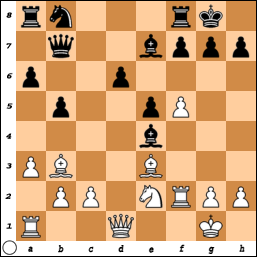
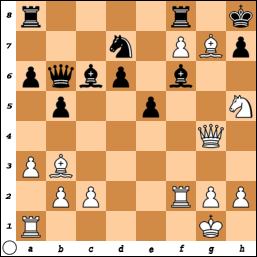
On Sunday, I won this game in the tournament at the Marshall Chess Club.
Round Five: Sicilian Defense, Najdorf Variation
Jim West (FIDE 2063) - John Walton (FIDE 1635), Marshall Chess Club 5/8/2016
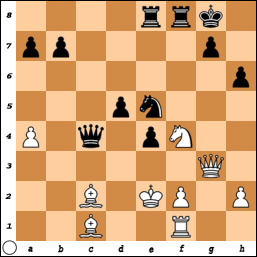
1.e4 c5 2.Nf3 d6 3.d4 cxd4 4.Nxd4 Nf6 5.Nc3 a6 6.Bc4 e6 7.Bb3 Qc7 8.O-O Be7 9.Be3 b5 10.a3 Bb7 11.f4 Nxe4 12.Nxe4 Bxe4 13.f5 e5 14.Ne2 Qb7 15.Rf2 O-O
16.Ng3 Bc6 17.Nh5 Nd7 18.Qg4 Bf6 19.Bh6 g6 20.fxg6 Qb6 21.gxf7+ Kh8 22.Bg7+, Black resigns.
Monday, May 9, 2016
Sunday, May 8, 2016
Chess Board Wrong in "Captain America" Film
The chess board is set up wrong in Captain America: Civil War.
Saturday, May 7, 2016
Baseball Cardinals Play Chess
Thanks to a gift from Rex Sinquefield, the Saint Louis Cardinals now play chess in their clubhouse.
Friday, May 6, 2016
Thursday, May 5, 2016
Wednesday, May 4, 2016
Tuesday, May 3, 2016
"Pawn Sacrifice" in Australia
Chess can be an unbelievably tense game, depending on the stakes. But the closest it has come to being a blockbuster sport, up there with football, was back in July 1972 in Iceland. Bobby Fischer, the tempestuous genius from Brooklyn, lined up against Russian champion Boris Spassky. The scene was full of Cold War symbolism: two nations facing off in a test of endurance and intellect, their performances watched by leaders on both sides.
Edward Zwick, director of a new film about Fischer, remembers the event well. He was watching on television, swept up in the strange drama of the occasion. What on earth was going on? Chess, that most internal of pursuits, was being covered like a major sporting event. “I was a devotee of Wide World of Sports,” he says, “and thought it was very odd that Wide World of Sports was suddenly covering a chess tournament — until the implications of its geopolitics began to be clear.”
The results resonate through history. Fischer, agitated, lost the first game after an uncharacteristic blunder. He forfeited the next when he failed to show up. When he returned, he blew away Spassky in a display of virtuosity that still gives aficionados goosebumps.
Four decades on, this triumph comes as the climax to Pawn Sacrifice, which stars Tobey Maguire as the man who many consider the greatest player. Liev Schreiber, speaking Russian throughout, plays Spassky.
Maguire conveys Fischer’s internal torment with great subtlety, having studied his world in detail. Zwick calls him “an actor of great concentration”, and says it helped that Maguire also happens to be a committed poker player. When it came to translate the drama of chess to the big screen, though, the filmmakers found another comparison.
“I felt that the metaphor of prize-fighting was actually pretty accurate,” Zwick says, “in terms of the number of rounds and the process by which one had to gain a shot at the title, and walking down those hallways and facing off against an opponent. It just felt very mano a mano in the way that prize-fighting is.”
Fischer rose to the top of the chess world in the shadow of the Cold War. He gained fame from an early age — a game he played when he was 13, featuring an audacious queen sacrifice, was dubbed the “game of the century” — before becoming the first American successfully to challenge Soviet dominance in chess. But his personal problems were legendary. Fischer was a genius, but he was also erratic, anti-Semitic, petulant and paranoid. A conspiracy theorist, he unnerved opponents with his behaviour almost as much as with his abilities: he complained, for example, about the sound of cameras during his match against Spassky. He later quit competitive chess and lived in seclusion, dying in Iceland in 2008, aged 64.
Fischer’s confidant, Father Bill Lombardy (Peter Sarsgaard), spells out the stakes in Pawn Sacrifice: “This game, it’s a rabbit hole. After only four moves, there’s more than 300 billion options to consider. It can take you very close to the edge.”
“To me,” Zwick says, “frankly even more interesting than the excess and the Cold War was this character study of this gifted young man whose greatest gift was also the source of his demise. I felt great sympathy for how isolated his genius made him and yet how he prosecuted that himself.
“And he was not a victim by any means. He was the architect of his own demise as well. So it was a fascinating character story to me, above all else.”
Maguire was involved in the film early on, as an actor and producer. He and producer Gail Katz approached Steven Knight (Locke, Peaky Blinders) to write the script, and David Fincher was an early option to direct. When Fincher moved on, Zwick came on board as director.
It was not an easy movie to make, with all funding having to be raised independently. Zwick has worked inside and outside the studio system, and says there are advantages and disadvantages of both. The fact Pawn Sacrifice is coming to Australia only now, several months after it appeared overseas — and even then it hasn’t managed a cinema release — indicates some of the challenges involved.
“It was me and Tobey out there deciding what we wanted this to be every day. And the company that financed it was very respectful of us in terms of our decisions. And the good news is that you have that experience of being very alone in your craft,” Zwick says.
“The hard part is that distribution of the movie is a much more challenging thing. Look, it’s coming to Australia now. I don’t entirely know why it wasn’t sold to Australia right away — maybe it didn’t get as much money as they wanted initially but now they do, I just don’t know. But that’s what you give up. You give up the 6000 television ads and the greater immersion in popular culture.”
In Pawn Sacrifice, the filmmakers have done the chess particularly well. They had little choice, considering just how closely they were being watched and how so many of Fischer’s games have become part of the repertoire. Consider this: last July, a thousand-word article appeared on the Chess.com website assessing the factual accuracy of Pawn Sacrifice. The film hadn’t even been released yet — the analysis was based on the trailer, complete with freeze frames and analysis.
Credit for accuracy, then, seems to go to Richard Berube, head of the Quebec Chess Federation, who worked as a consultant on the film. Careful attention was paid to the selection of pieces, clocks and score sheets, as well as the moves themselves. As a result, it’s possible to pause the film at certain points and identify real positions from Fischer’s games.
Zwick says it was important to be as faithful as possible while recognising that some “dramatisation and compression” was going to be required. “The movie, I think, does as good a job as it possibly can without trying to teach the audience chess,” he says.
Zwick has turned to various experts for many of his films, among them Blood Diamond, Love and Other Drugs and The Last Samurai. His latest film, a Jack Reacher sequel with Tom Cruise, is due for release this year.
“I’ve had technical consultants from various branches of the military, I’ve had people who were pharmaceutical salesmen, people who were historians of certain periods, and it requires someone to serve what they believe to be their life’s calling and at the same time service to a film that is not intended to be didactic but rather to be entertainment,” he says.
“So they are in fact on a razor’s edge of serving two masters.
“But the more sophisticated among them regard intent and purposes to be very important in all of this. In other words, if it is exploitative and you’re not trying to honour people who really try to take it seriously then I think that would offend people who are serious about it. If you are trying to do as good as you can, given the limitations of the form, and yet believe that you’re communicating something essential at the heart of the subject, then I think they tend to be generous.”
Pawn Sacrifice received praise from Magnus Carlsen, the No 1 chess player in the world, a Norwegian grandmaster who recently appeared in a Porsche ad alongside Maria Sharapova and Muhammad Ali. In early 2014, Zwick and Maguire were in Silicon Valley when Carlsen played six players simultaneously on a timer while blindfolded. (He won, obviously.)
These were humbling moments for Zwick, a social player.
“I’ve had this experience more than once in my life,” he says, “where you think that you know something about a profession or about a sport and then you encounter people who are world champions. And you realise that what you do has nothing to do with the realities of the sport.”
Monday, May 2, 2016
Marshall Sunday Game/45 5/1/2016
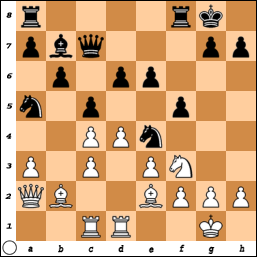
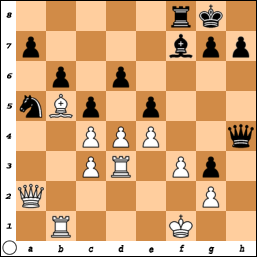
On Sunday, I finished with a score of 2-1-1 in the tournament at the Marshall Chess Club.
Round One: Dutch Defense
Anthony Wong (USCF 1835) - Jim West (USCF 2210), Marshall Chess Club 5/1/2016
1.c4 e6 2.Nf3 f5 3.e3 Nf6 4.Nc3 b6 5.d4 Bb4 6.a3 Bxc3+ 7.bxc3 O-O 8.Be2 d6 9.Qb3 c5 10.O-O Nc6 11.Rd1 Na5 12.Qa2 Ne4 13.Bb2 Qc7 14.Rac1 Bb7
15.Nd2 Rf6 16.f3 Nxd2 17.Rxd2 f4 18.e4 e5 19.Rcd1 Bc6 20.a4 Raf8 21.Bc1 Qe7 22.Rd3 Qe8 23.Bd2 Bxa4 24.Rb1 Bc6 25.Be1 Rh6 26.Bf2 Qe7 27.Bd1 Be8 28.Ba4 Bf7 29.Bb5 Rg6 30.h4 Rg3 31.Kf1 Qxh4 32.Bxg3 fxg3
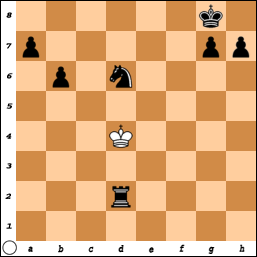
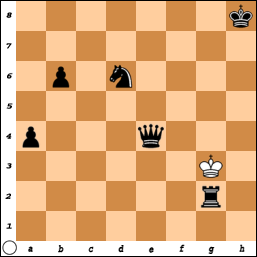
33.Ke2 Bh5 34.Ke3 Qf4+ 35.Ke2 Qxe4+ 36.Re3 Qf4 37.Qd2 exd4 38.cxd4 cxd4 39.Re6 Bxf3+ 40.Kd3 Qxd2+ 41.Kxd2 Bxg2 42.Rg1 Bh3 43.Rxd6 g2 44.Bc6 Nxc4+ 45.Kc2 Nxd6 46.Bd5+ Kh8 47.Bxg2 Rf2+ 48.Kd3 Bxg2 49.Rxg2 Rxg2 50.Kxd4 Rd2+, and Black wins in ? moves.
Final position
Sunday, May 1, 2016
Marshall Saturday Game/60 4/30/2016
On Saturday, I played this game in the tournament at the Marshall Chess Club.
Round Two: Philidor Counter Gambit
Nancy Wang (USCF 1967) - Jim West (USCF 2204), Marshall Chess Club 4/30/2016
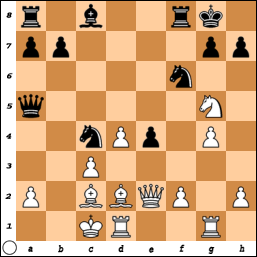
1.e4 e5 2.Nf3 d6 3.Bc4 f5 4.exf5 Bxf5 5.d4 e4 6.Ng5 d5 7.g4 Bc8 8.Bb3 Nf6 9.Rg1 c6 10.c4 Bb4+ 11.Nc3 O-O 12.cxd5 cxd5 13.Bd2 Bxc3 14.bxc3 Nc6 15.Qe2 Na5 16.Bc2 Nc4 17.O-O-O Qa5
Subscribe to:
Posts (Atom)